Tuesday, January 17, 2012

The Cow Chase

I go running at roughly the same time every day along the same exact route.  It’s a long and newly paved road out of town with very little traffic.  During my run I see maybe five vehicles.  It’s a pretty road; it winds through farmland and forest, it’s hilly, and it’s well shaded.  There are lots of different birds and way too many dead skunks.  Horses and cattle graze freely in the banks of tall grass between the barbed wire fences and the road.  White egrets, when not hitching rides on the backs of the animals, follow them around collecting the worms and bugs yanked up as the grass gets eaten.  I could run in town if I wanted to but it can be miserable at times since those that burn trash generally do so in the morning.  So this road out of town is my only real option, but not a bad one.
My punctuality means there are certain people that I pass by nearly every day.  My running may have been a bit of a novelty to them at one time, but that era is long gone.  Most of them I have come to know or at least recognize and we acknowledge each other with a little wave and an adiós, which means hey (don’t check your dictionary), and I continue on my way.
The amount of people out and about at such an early hour is astounding.  I swear there’s not a person in this town that ever sleeps past 6:30am.  Many of them have things to do but some of them certainly don’t.  Among those that do have things to do is a family of three men, owners of a small dairy farm, that I see everyday without fail.  They have two pieces of land just outside of town, one on the east side of the road and the other on the west.  They keep the calves and cows separate so that the calves don’t go and drink up all the milk before the people get to.  The animals don’t seem to appreciate being kept apart and protest in desperation.  They talk to each other from their pens across the road; the cows moo and the calves moo back pitifully.  Some of them figure out how to escape and wander where they will.  Those that make of a habit of it have giant sticks shaped like slingshots tied to their horns or necks.  It’s supposed to keep them from sneaking through the barbed wire by making it a trickier maneuver, but I see so many animals wandering in the middle of the street with sticks tied to their heads that I get the sense it’s not so effective.  But in the morning, at exactly the same time I go running by, the three men bring the calves and cows together to feed and to be milked.  One might assume they would bring the calves over to the cows’ side or the cows over to the calves’ side, but they actually bring them both to meet in the middle and work in the street or just off to the side of the road.  And that’s where I see them.
These men almost never say adiós to me, and with good reason.  That reason being that they probably don’t like me too much.  It turns out that cattle, somewhat skittish, become frightened when people come running towards them.  I always try to stay as far away as possible and take a path way off to the side to keep from spooking them, but inevitably a few scatter when they see me.  Some of them turn in circles, some of them sort of group together, and every so often some of them dash off in the same direction I’m running.  It’s the bolting of the livestock that causes the animosity.  I’m a disruption.  As I come running upon them I can see from a distance a very smoothly run and problem-free operation.  But as I close in and pass by, the three men, given no warning, look on helplessly as I chase a few of their cows away down the road.  The first few times I didn’t really do anything; I just kept on going behind their cows.  Eventually I felt compelled to help, mediocre as this assistance may be.  I would make noises to get their attention so they might come back.  One family that I know controls their cows by yelling rana! rana! rana! at them.  It means frog! frog! frog!  I felt funny saying it.  I tried it out but my doubt and awkwardness caused me to do so unconvincingly.   It didn’t do a thing.  I have a feeling it may not be a common practice and I got embarrassed when I thought about the men seeing me chase their cows away while meekly calling them frogs.  Finally I would try slowing down or stopping entirely but even when I stopped the cows kept going, so now I just don’t stop.
I know exactly where they’ll end up.  They make it to the stream not far off, about half a kilometer from where I started pursuing them.  They never cross the bridge; instead they head for the dead-end made by the meeting of the stream and the fence, get stuck, and just give up.  As I go on by their individual gazes follow me in unison, like they’re watching a slow-motion tennis match.  Since cows have no eyebrows and are therefore expressionless beings, I can’t be certain whether they’re running out of terror or joy.  I like to assume joy; and if not joy, exhilaration.  That way, when I’m out slowing milk production, at least I know the cows, along with myself, are having a good time.
(Thanks to Zac for the top photo, taken on Isla de Ometepe before the 18k)

Tuesday, December 6, 2011

What Lives in My Backyard


Disclaimer:  This post is rather boring.  I originally wrote it to remind myself, after I’ve moved on, of what my patio looks like.  Of course I have plenty of pictures of various bits and corners and nooks out back, but it’s too large to take one that encompasses the entire area.  My house gets so hot during the day that I really spend an incredible amount of time in this very tiny and private corner of Nicaragua.  There are no accompanying stories or amusing anecdotes but I still have a lot of fond memories from being out there.  Anyway, I decided to post it because there’s no reason not to.
A giant avocado tree dominates my backyard.  It has large thick leaves that are never shed, so everything under it is cast in permanent shadow until the sun dips down far enough to sneak under the lowest branches.  It’s often breezy enough so that rays of sun reach the ground through the bending and waving branches, but there’s no steady direct sunlight until dusk approaches.  For two months out of the year I ate the best avocadoes I have ever tasted, perfect texture and perfect flavor every time.  For the other ten months out of the year I thought about the avocadoes that I got to eat for two months out of the year.  When they were in season I ate them for breakfast, lunch and dinner.  I put them in omelets, turned them into guacamole, and ate them plain with a bit of salt.  My neighbors came and took them by the armfuls.  The owners of the property sold them out front for twenty cents a piece.  Still there were some left on the ground to rot away or be eaten by fire ants.  It’s a tree determined to reproduce.  Luckily I’ll get a chance to relive this once more before I leave here.  This is a picture of an avocado from my backyard:

It is perhaps the dullest picture ever taken, but one I look at frequently and longingly.
And beneath the avocado tree there is more.  To capture the sun that is available, the banana trees sprout enormous leaves, about five feet long and two feet wide.  They shoot straight out the top of the tree in a tightly wound scroll.  As they get longer the leaves start to unfurl.  They slump to the side and spread out around the trunk.  Banana bunches start from the same spot the leaves do, but are preceded by a purple flower the size of an artichoke.  As the stem lengthens gravity pulls the flower straight towards the ground.  The flower sinks closer and closer towards the earth and the hand-sized petals, one by one, curl up to reveal a cluster of tiny bananas hidden beneath.  Within a week all the bananas are revealed, sometimes numbering as many as 40 or 50 to the bunch.  They swell in size during the following months and the tree often cannot support the weight of its own fruit.  My neighbor comes out and wedges a V-shaped branch underneath it to keep it from tipping.  When the first banana shows signs of yellowing, the entire bunch is cut and can ripen away from the tree and out of the reach of birds.
The avocado tree and banana trees comprise the most noticeable flora growing in the backyard, but there is a lot more going on around them.  As I write this blog, comically large fruits, dangling from the trunk just beneath the branches, dominate the slender papaya trees.  On the outskirts of the patio there is a lime tree, a noni tree (a fruit that smells horrible and tastes worse), a rose bush, a mango tree, hot red pepper bushes, bell peppers, and a chayote plant that covers the fence in ivy.  The coconut trees are so thin, tall, and well hidden that they go largely unnoticed until you are standing beneath and them looking up.  Other medicinal plants and herbs, most of which I can’t name, grow all over the place, in the ground, in pots, in small plastic bags, and even in an old tire sliced in half.  There’s always tons of mint, basil, aloe, cilantro, and oregano to be used and enjoyed.  I myself have herbs planted in red clay pots that I constantly move around throughout the day to take advantage of the small patches of sun that move across my patio as the sun rises and falls.  My neighbors also have an interesting plant that is harvested for the leaves, which are hung to dry then used as scouring pads.  They feel like sandpaper and are tough to tear.
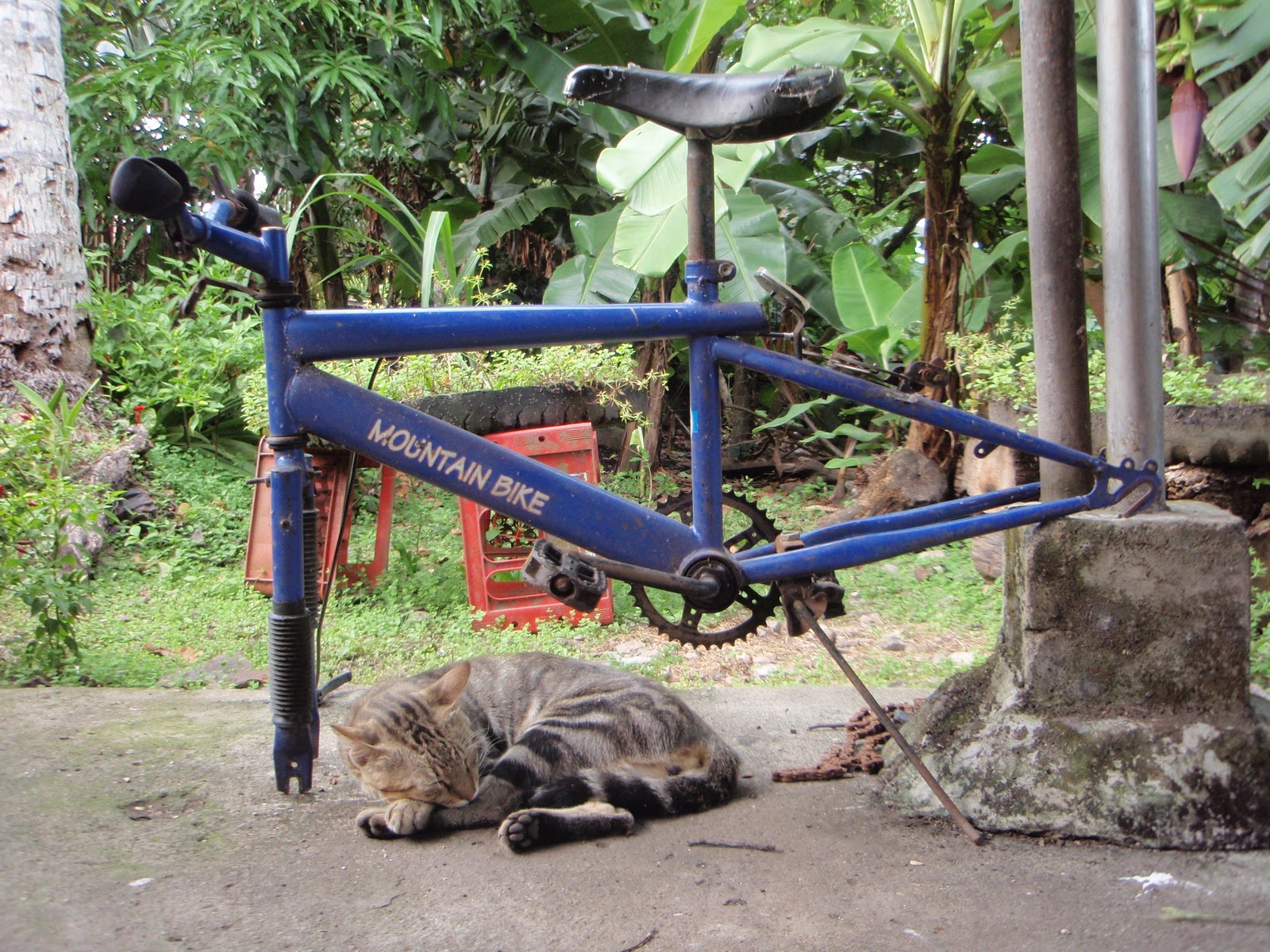
My backyard is green, almost jungle-like, which attracts lots of little animals.  The larger animals (monkeys, sloths, alligators, snakes) stay far out of town and stick mostly to the rivers.  During the day there are birds of every size and color (red, orange, yellow, green, blue, black, brown, and white) chirping and hopping between all the twisted branches of the limón dulce tree or perched in the more orthodox branches of the avocado tree.  At night the toads come out and soak in the puddle formed underneath my leaky lavadero.  When I venture outside after dinner to throw food scraps on my compost heap I have to use the stingray shuffle to keep from smushing them in the dark.  Every once in awhile after a particularly heavy rainstorm a lost turtle with pass through as well.  Mice scurry out of an old box sitting near the wall as I pass closely by.  They hop up the cement stair leading into my house and hide in a cabinet beneath my sink, a cabinet in which I store nothing and refuse to open.  The cat, despite its reputation, doesn’t seem too concerned with them.  He’s much more interested in getting my attention so I’ll scratch him behind the ears before wandering off to sleep beneath an old useless bicycle propped up on my patio.  Other less pleasant creatures take up residence as well.  For some unknown reason I welcome their presence.  Maybe they make it seem complete.
Off to the right are the patios of the two houses that share the backyard.  In one house live an old man, his wife, and their son.  In the other house live his daughter, her husband, and their children.  The three houses, including the one I rent from them, form an “L” around the yard.  Their patios are simple, rustic, and cozy.  They cook on wood burning stoves that are in constant use and make everything smell like a campfire.  I like to sit on their wooden benches and talk to them as they feed me things I can’t remember the names for.  I give the plate or bowl back, tell them it was excellent, and make my way back towards my hammock that is stretched across my entire patio.  It may not be the most efficient use of space but there is always plenty of room to hang laundry to dry.  And between laundry and hammocking there isn’t much else I do back there, so there’s no incentive for change.
So this scene dominates my home life.  There is very little else to say other than that this is what it’s like to be behind my house and that’s why I spend so much time out there.  Of course on particularly clear nights it’s hard not to leave the patio, walk down the street to the dock, and stare at this:

Tuesday, November 1, 2011

Zancudos


 When not fighting off swarms of chayules, we keep our hands busy by slapping the mosquitoes buzzing around our ankles.  And since the houses generally have no screens and tons of gaps and cracks and holes in the walls, there’s no keeping them out.  Indoors is still outdoors.  They’re around all the time but at dusk and dawn they’re absolutely unrelenting.  The thought of wearing insect repellent every single day for two years seemed less than appealing so I generally protect myself with clothing.  I’m still not comfortable with the idea of using pants, socks, and shoes from the moment I step out of the shower until I go to bed at night, regardless of the heat, but I do it anyway.
From the hours of about 8am to 4pm the mosquitoes’ favorite pastime seems to be clinging to the side of my mosquito net.  They’ll leave for a few hours to feast (not on me if I can help it) then return engorged with blood just before I go to bed.  It’s an ominous scene to walk into my bedroom and see them all waiting there so still and patient.  Sometimes as I try to get into bed they sneak in the net with me, but I’ve perfected this sort of magician swoop where I grasp the net and quickly spin myself underneath it.  I disappear behind the mesh cloth and the mosquitoes are left dazzled.  But before I do this I usually smack a few for good measure.
To combat the mosquitoes the town uses a combination of methods, the most common of which being chemical warfare.  The first chemical is known as abate; I guess the name pretty much sums up its general purpose.  It’s a supposedly harmless powder of undetermined ingredients that MINSA (The Ministry of Health) throws into the tanks and buckets of stored water that people keep at their homes.  The eggs won’t hatch and the potentially malaria or dengue-ridden mosquito is left without an heir.  I assume it works but I’ve never tried it myself.  I go with the less traditional method of using a lid to keep mosquitoes and other unwanted creatures out of my water.
The second phase of the chemical warfare comes in the form of a disturbingly unprotected man wielding some sort of beefed up leaf blower through every room of every house in town.  He wears plastic chaps and a construction helmet, but since things aren’t usually falling on his head I believe it’s just for style.  You would assume lungs and eyes would be the most susceptible to damage and therefore a top priority when it comes to protection, but a mask and goggles aren’t included in the gear.  He’s probably ingested so much of the chemical that just having him nearby would be sufficient for keeping any number of mosquitoes safely away, like a human citronella candle.
The way you’re warned that your house is about to be fumigated is by the guy blasting a huge puff of smoke through an open window into your house.  This gives you maybe four seconds to drop what you’re doing and get the hell out.  It’s extremely inconvenient when you’re in the middle of cooking a meal or showering or dozing in a hammock.  But whatever I’m doing I try to get out quick.  And not that I don’t trust the guy whose profession it is to follow a trail of poisonous gas around town, but I still instinctively cover my face and search frantically among the piles of papers on my table for my wallet before fleeing.  I see my neighbors already hurrying across the street.  One of them is gently carrying a rusted casing from an old fan that has been converted into a home for a pet parakeet.  I meet the rest of my neighbors out on the street and we talk about all the struggling face-up cockroaches inevitably awaiting us inside.  The smoke rising up and pouring out through the spaces between the walls and the roofs of every house gives the impression that the entire neighborhood is burning to the ground.
We sit and watch for ten minutes or so, waiting for it to clear, then head back to our respective houses to see what’s alive, what’s dead, and what’s somewhere between the two.  The poison is an equal opportunity killer so in addition to the cockroaches and mosquitoes, it also kills the things that eat the mosquitoes, like geckos and spiders.  I take the broom and sweep everything out the backdoor, leaving it for the birds when they return.
They come and spray pretty frequently, maybe every other week or so.  There are fewer mosquitoes after they spray, but the change is temporary.  Within a day everything has pretty much returned to normal.  And with no predators the mosquitoes seem to come back stronger than before.  So there are still mosquitoes, there are still cockroaches, there is still malaria, and there is still dengue.  But for one glorious evening I can wear shorts and sandals.

Tuesday, September 6, 2011

Soccer In The Campo


I tagged along with the youth soccer teams on a trip out of town.  I went to watch them play and to kick the ball around a little because I don’t get to do that as much as I’d like.  There were two teams and they were planning on playing each other.  We had to leave town because our soccer field is mostly underwater due to the flooding of the lake.  After a good rainstorm I wouldn’t even call it a soccer field anymore, I would just call it the shallow end of the lake.  The older teams, for the most part, can handle playing in the shallow end of the lake.  It’s not perfect but they play the best they can.  They’re much taller but they still have trouble slogging through the mess.  When they kick the ball it never rolls because the whole field is submerged.  But these tiny kids can hardly even walk through it.  So an away game was planned.
I showed up at the health center early on a clear Saturday morning, ready to leave.  I was one of the first few to arrive so I waited around as more and more people showed up.  Eventually, when everyone was there, we took up the entire sidewalk and spilled into the street.  In front of the health center were 34 children, two coaches, myself, a driver and his buddy, and one white pickup truck with a busted battery.
            We smashed the kids into the back, all of them.  There’s no such thing as an over-crowded vehicle, even when children are involved.  The health center is on a hillside so we gave the truck a nudge, it rolled down towards the lake, the driver popped the clutch and turned the key, and they disappeared around a corner.  Thank God, I thought.  There was not an inch of free space in the back of that thing.  I was glad not to be in it.
            “So how are we getting there?”  I asked cautiously.  Just then the truck swung around the corner to pick us up.  So we got in the truck too…sort of.  We got mostly in the truck.  I only had a leg sticking out but both of the coaches rode the 40 minutes standing on the bumper and holding onto the frame.  We went to some far-off community down a long, mucky, bumpy road.  We got off and the kids played soccer for two hours.  It rained on and off, sometimes heavy.  The field got muddy but held up nonetheless.  The kids were having lots of fun.
 The owner eventually kicked us off on account of tearing up the wet grass but no one seemed to mind because we were wrapping things up anyway.  As the kids rinsed the mud off in some large puddles, the driver changed one of the tires.  We had picked up a nail or something along the dirt road.
With the tire changed, the driver attempted to start the truck.  But trucks with broken batteries don’t start, even if they do have four good wheels.  The only way to get it going was to give it some forward momentum and pop the clutch.  But a muddy, flat, deeply rutted road isn’t the ideal place to push a truck.  A bunch of the kids, 25 or so, surrounded the truck on all sides and grabbed hold.  Their cleats sunk into the mud, their legs slipped out from under them, but somehow they were able to get the truck rolling.  It didn’t work on the first attempt.  They probably pushed the truck about a quarter mile before finding a smooth patch.  It finally rumbled to life.  I followed along the entire way snapping photos.  We squeezed back in and headed home.
The kids were rowdy, worked up from the game.  During the trip they played a game that consisted of slapping each other on the head and face then blaming it on the person next to them.  On our way back we ran over someone’s rooster.  “Para la sopa!” everyone yelled in unison.  Rooster soup.

Monday, July 11, 2011

Noise!!!

It’s hard to say which noise will force you out of bed in the morning but it’s safe to say that sound will get you before sun.  And everyone who has come to visit me in my site has made roughly the same pre-dawn assessment: it’s really goddamn loud here in the morning.
             The ancient diesel engine on the bus to San Carlos starts rumbling around 5am.  Within 30 minutes it has left its parking spot a half block from my house and starts bellowing to inform the town of its presence.  The sound of the horn is so loud and horrible that in an instant it can turn my dream into a nightmare.  Every time it wakes me up I plot my revenge.  I envision sneaking over there in middle of the night, dressed in all black, to sabotage the thing by removing and destroying whatever part can’t easily be replaced.  I imagine myself being an anonymous town hero.  But for now the racket continues.  And just in case I pretend to ignore it with a pillow over my head or fingers stuffed in my ears, it takes advantage of the prevailing winds and fills my house with thick smoke.  I’m still not used to it all.  I wonder if anyone is.  I’ve taken this bus to San Carlos on occasion.  During the two hour trip the driver blares his evil horn outside of literally every single house we pass along the way.  There is no discrimination between homes already teeming with life and those that are still obviously closed up from the previous night.  Sometimes people are waiting on the side of the road, clearly signaling for the bus to pull over, and he honks at them, too.  But this affords me the opportunity to practice all the swear words I’ve learned in Spanish because as we bounce along I like to imagine all the things that the people in the houses must be saying about us as we make sure they really don’t want to come with to San Carlos.
            But I’m probably not used to this wakeup call because it’s usually not the bus that gets me.  Birds, aside from doing other useful things such as shitting on my drying laundry and eating my herbs before I get to, serve as particularly effective alarm clocks.  They announce the coming of the sun by screaming at each other from the limbs of the avocado and mango trees out back.  The sound of a few birds chirping can be pleasant and relaxing music; but if you mix too many species in too small a space it ends up sounding more like a cramped pet store than a harmony of wildlife.  And because they are competing for physical space as well as aural space, many of them make their way onto the zinc roof of my house.  They awkwardly hop around on the corrugated metal, scratching and clawing away with their talons and beaks.  They have about as much grace and coordination as a small toddler trying to walk across a moon-jump.  The whole scene gives me the impression that they’re just out there trying to annoy each other, or me.  But in the end I can’t really complain because I suppose it’s actually me who is on their turf.
            As early as the birds start, this generally isn’t the first time I’m woken up during the night.  The birds’ pre-dawn anthem seems like it should be the job of the roosters that strut around nearly every patio in town.  But the roosters here, for whatever reason, tend to be overzealous in their work and announce the coming of the new day around 2 or 3am, long before anyone really cares.  One starts, the rest follow, and by the time actual dawn rolls around they’re just too exhausted to do the job right.
            But the sounds about town aren’t restricted to the early hours of the day.  The Evangelicals screech and cackle their way through the evening hours the same way the birds do through the morning hours.  After giving a quick listen, one can surmise that they’re all attempting to make more or less identical noises and are doing so for the same reasons, but the similarities end there.  The solos are potent enough to rouse a strong headache but when done in unison the final product will make even the most devout individual question their God’s existence.  The birds I give a pass because they’re birds, but these are humans we’re talking about and they ought to know better.  I don’t know much about The Bible but I would guess there’s something in there about not making God angry.
            The Catholics don’t allow the Evangelicals to be the only religious noisemakers in town.  Better equipped vocally and with a stronger following, they take to the streets to belt it out.  Sometimes they parade around at 5pm on a Tuesday, sometimes it’s 4am on Saturday, sometimes it’s noon on a Thursday.  There’s no real pattern to it.  I guess they just go when they’re feeling particularly pious.  And, interestingly enough, the Catholic Church here in Nicaragua has more firepower than a small army.  Not only do their parades feature loud singing and giant painted statues of religious figures with lifelike hair, they also come with explosives.  Extremely powerful bottle rockets are the standard, but they also fire blanks out of crude metal contraptions that sort of resemble potato guns.  There’s no beautiful fireworks display, it’s just really loud explosions.
            The sounds of the day certainly don’t end there.  I could go on and on about how my ears are constantly bombarded throughout the day and night.  There’s so much more I could mention, like how I’d be breaking no social norms by blasting music out my windows at 3am.  I know this because my neighbors often do it.  They fire up the stereo, play a song or two, and then give it a rest until morning.  Or how during the fiestas patronales a huge mass of people take to the streets from 4am until 6am every day of the week, cheering, drinking, lighting off fireworks, playing music, and dancing.  They do it to ward off the evil spirits and bring good luck for the coming day.  I suppose if you’re woken up by fireworks outside your window at 4:30am while nursing a hangover there’s really no place to go but up.  So the system works.  And on top of all this you have the street vendors.  People walk up and down the streets yelling to each house to drum up business.  Generally each product is at least slightly different and everyone has his or her own style when it comes to the sales pitch.  I can usually tell what’s coming from two blocks away not because I can hear the words coming out of their mouths but because I can hear the pitch and tone of their individual calls.  I always know who’s coming long before they get here.  And there’s so much more I left out.  And sometimes, even though it’s all going on, I can’t hear any of it because the rain is hitting the roof with such ferocity.
I obviously think about this a lot, and I complain about it in a nearly equal amount.  But all this is a testament to how closely intertwined everything is here.  I can’t help but continually ask myself if I’ll miss it a year from now.  I wonder if the transition between such opposing lifestyles will be a difficult one.   Here I live in an environment where the private life is essentially non-existent.  Everyone’s life is public information and there is no hiding.  Everyone’s story is heard and told, no matter how mundane it may be.  This opposed to a place where isolation really knows no bounds.  In America you can be as removed from society as you please.  At times I wonder if I’ll find the extreme stillness there to be as distracting as the extreme intensity here.  Time will tell.  I’ve never been much of a believer in reverse culture shock but attitudes can certainly change.  I have one year done and one year to go; I’m as far from my past as I am from my future.

Wednesday, June 1, 2011

What's There to Eat?

 Food in Nicaragua is different.  Which means attempting to be a vegetarian in Nicaragua is different.  Depending on with whom you’re talking, the word “vegetarian” can take on a variety of meanings.  Anything from “you don’t eat beef but you’ll eat chicken” to “ok so you eat your meat with vegetables” seems to be an acceptable definition.  Originally I had decided to forgo being a vegetarian for fear of insulting anyone or appearing as more of an outsider than I already was.  I wanted to be accepted so I decided I would eat what was given to me and be grateful for it.  In fact, this was brought up during the interview process for Peace Corps.  After divulging that I was indeed a vegetarian I had to respond to a number of “likely” scenarios as a way to evaluate how offensive I might actually be in a given community.  Now I’m only paraphrasing here and I went through this process about two years ago, but I believe some of these “likely” scenarios involved situations such as having the entire village scrape together what little they had to buy and slaughter an enormous animal for my arrival, a group of elders directing me to the front of an expectant crowd of hundreds, being served a large portion of this beast, and having everyone looking on disappointedly as I slowly nudge the plate away and twist my face in disgust.  “How would I react to this situation?” I was asked.
“I’m sorry, I’m sorry!” I immediately begged for forgiveness.  “I didn’t mean to be so offensive (sniffle) I’ll eat the meat (sniffle sniffle).”  So that’s pretty much how it went…I think.  Anyway, that’s where it all started.  That’s when I first caved.

Well there never was any big welcome feast.  But during one of my first few weeks in Nicaragua, I was asked if I would like to go shopping for food at the market in Masaya with a friend I had made from my town.  I had already been to the market with others from Peace Corps but I went in hopes of seeing it from the perspective of someone who had made a weekly habit out of the trip and thus knew the market inside and out.  And he did.  He snaked his way without pause or hesitation through the maze (and I mean maze) of tiny shops and stores packed together as tightly as the people on the buses they took to get there.  I struggled to follow him through the throng of shoppers occupying the network of narrow alleys connecting the different sections hidden behind the entrances.  The market is a collection of individual stores, with individual owners, under individual zinc roofs, but somehow they’re all intertwined and connected so that each roof covering each store supports the others around it to make one enormous life form.  It can be hot and crowded but it’s all quite manageable…that is until you find yourself in the butchers’ alley.  The step between slaughter and supermarket that exists in the United States is noticeably absent here…or should I say noticeably apparent?  There’s no refrigeration for the meat and on hot days the odor, to put it gently, can make your knees buckle.  The proprietors keep the flies off the freshly stripped carcasses with thin towels or feathers tied to sticks.  All parts of the animals are present because they are all in demand.  The bits and pieces that may seem worthless are perfect for making into soups.  Chicken heads and feet are readily available because they’re cheaper to buy for your dog than a bag of Alpo.  And I’m still unsure what the purpose is of the pig heads with the tongues hanging out.  I paint this picture not to persuade or dissuade anyone from anything, but I think it’s important to realize that certain things are much bloodier messes than they may first appear, literally.
But I must have successfully stifled my gasps of horror and held myself together pretty well because my friend said with a completely straight face, “This is where Hooper goes when he wants to get meat.”
And I said, “Ummm...”
And I find the presentation of meat in my town to be no more appetizing.  There is a family in my community that raises pigs and sells the meat.  It’s not a large-scale operation so you can’t just show up at their home whenever you’re looking for some ribs.  Rather, when they’re ready, they bring the meat to you.  And tons of stuff, almost everything, is sold door to door here.  All kinds of food, kitchen supplies, movies, mattresses, produce, just about anything can be bought from the comfort of your own home.  I guess it’s sort of like the Internet.  So there’s no reason to be surprised that raw pork makes the list as well.  And it’s wheeled down the street in a wooden wagon big enough for an entire butchered pig.  I’ve peered into the cart pretending to be an interested customer, but I really just wanted to see.  All parts seemed to be present; they were just out of order.  And all the while, as I cringed at the carnage, I imagined a giant “Eat Local” sticker pasted to the side of the cart and splattered with blood.  And I imagined this because I knew where this pig came from.  And I am also quite sure this pig was fattened up on watermelon rinds, cornhusks, old beans and rice, and anything else that would otherwise end up in the garbage.  And I believe this because pigs, like chickens, eat absolutely anything.  Waste goes unwasted, people get food, and a family has a business.
           And these are just a couple of examples of a collection of experiences I’ve had and observations I’ve made that have shaped my views regarding vegetarianism in Nicaragua.  Though through it all I’ve largely confused myself.  These experiences have grayed the line between right and wrong.  I still struggle with how I should resolve these conflicting thoughts.  And what adds to the difficulty is that I still enjoy the taste of meat.  Even after seeing a chicken that was tied to a stake in the ground and plucked from the waist down, then later split down the middle and hung over my fence to dry.  Or seeing a dog lick blood off the inside of a wheelbarrow used to sell pieces of a pig from door to door.  Or still being able to recall the stench of that market with alarming clarity.  And I tell myself that if I eat chicken this one time at my neighbor’s house, I may as well not worry about eating beef at a birthday party or pork at my old host family’s house.  Because it’s just the way it goes here.  And the cycle never stops.  So I have decided the only way to reconcile my feelings and find peace of mind is to take a stance and hold firm.  Cold turkey…errrr carrot.
(thanks for letting me use your photos without asking, Pops!)

Monday, May 9, 2011

Chickens Keep Fallin’ On My Head

Even a decent seat on a relatively uncrowded bus can make for a droll ride from time to time.  As I boarded a bus bound for site I took the last available spot underneath two wide, flat boxes punched with air holes.   Very suspect.  But the cargo was nothing more than a bunch of tiny yellow chicks fresh from their shells.  It’s not uncommon to place your bag on the overhead rack and see a chicken raise its beak over the edge of some nearby cardboard box, give a few clucks, and duck back in; so I didn’t pay much attention to the boxes above me.  The odor of bird dander was a little over-bearing at times but when the bus was in motion the rushing wind from the open windows dissipated it to a point where it was hardly noticeable.  Of course the constant chirping of a hundred hungry chicks was enough to remind me that they were still right there over my head.
As we traveled along and the sun beat down and the bus filled up I could feel the temperature rising a bit.  Well it must have been mighty hot being crammed into those tiny boxes near the roof of the bus, and any living and breathing creature would probably be overcome by paralyzing claustrophobia at some point.  So, rather than waiting for freedom that may never come, some of the chicks started to take advantage of the poor construction of their temporary cages.  They desperately began looking for a way out.  And within a few minutes something plopped onto my head and landed in the lap of the man to my left.  It was obvious that one of the birds had found an escape route that led directly to our seat.  And whenever something living unexpectedly lands on you, no matter how harmless and adorable, there’s always that one instant of surprise and terror that manages to manifest itself in a very physical way.  I believe I flapped my hands and said something like, “Hooweeahahhwww!”
The man held onto it for three or four minutes, stroked its head, commented on how pretty it was, and then handed it to me.  Not knowing what else to do, I placed it flat on my palm and raised it above my head with the hope that someone would come to claim it.  Really, nobody wants it?  I understood; I didn’t really want it either.  So I stood up, bent back a flap on the box, and dropped it in.  Within 10 minutes another bird looking for some fresh air followed his friend out the hole, onto my head, and into the man’s lap.  The man repeated his actions then handed it off to me.  Well this time I followed suit and did as he did: I held it, stroked it, and the thing pooped on my shirt.  It wasn’t ideal but how can you get mad at an Easter peep?  It was, however, enough to earn him a trip back to lockup.  It had already become quite clear that these weren’t isolated incidents.  A pattern was forming.  I was soon proven to be right.  Rumor must have spread quickly about the road to the other side.  Birds were plunging onto us at regular intervals.  All attempts to block the escape route failed.  The bouncing of the bus was enough to create a little separation and leave the breach wide open.  So for the next two hours I rode along with baby chickens bouncing off my head and always into the lap of the man seated next to me.
For the entirety of the remaining trip I carried a smile I couldn’t contain.  And it wasn’t the kind of bitter smirk that finds itself paired with narrowed eyes used to mask ire or frustration.  It was an expression rooted in absolute joy.  I smiled because baby chickens had fallen on me and I smiled at the idea that they would probably continue to fall on me.  I smiled at the thought that this was simply part of the daily occurrences of my life, something perhaps to be repeated, rather than being an amusing anecdote brought back from some fleeting vacation.  And I smiled when thinking that the environment that surrounds my life is so entirely different from what I imagined it would be just a few short years ago.  What an interesting place I have found myself in.
(Thanks for the great photos, Dad!)